
There are many different sites and databases that provide access to information about genes and diseases. The following is a selection of sites you might find helpful. You can search these sites based on several different identifiers for your gene:
- Ensembl Gene ID (e.g. ENSG0000001234)
- Gene Name (e.g. GAPDH)
- Uniprot ID
- PDB ID
Agora
Agora contains information about all the targets on your list and why teams nominated them. It also shows results from gene and protein expression studies of AD patients and non-AD cases.
- Search for your gene using Ensembl ID or Gene Name
- Learn why teams nominated these genes (Nomination Details Tab)
- How many teams nominated this gene?
- What kind of analysis did they do?
- Why was the target selected?
- What is the predicted therapeutic direction?
- Examine evidence from molecular studies (Evidence Tab)
- Is RNA significantly higher, lower, or not changed in AD patients?
- Is protein significantly higher, lower, or not changed in AD patients?
- NOTE: you can find out if there is a significant association hovering over the red dots on the plot.
Open Targets
The Open Targets site summarizes information from multiple sources and shows a summary of evidence for a gene’s association with different diseases.
- Search for your gene using Ensembl ID or Gene Name
- NOTE: You can also link to Open Targets from Agora’s Gene Summary Tab
- Examine multiple kinds of evidence for this gene’s association with AD
Protein Data Bank
The Protein Data Bank site hosts protein structures deposited by researchers across the globe.
- Search for your gene using the PDB ID.
- View details about the protein structure for this gene.
UniProt
UniProt contains information about general functions of protein targets.
- Search for your gene using Uniprot ID.
- Learn about this gene’s biological function.
StringDB
StringDB shows protein:protein interactions based on a compilation of many different data sources.
- Search for your gene using Ensembl ID or Gene Name
- Learn interaction partners for this gene.
BrainRNAseq
The BrainRNAseq site provides a summary of RNA expression data from different cell types in the brain for both mouse and human brains.
- Search for your gene using Gene Name
- Learn which cell types this gene is expressed in.
NIAGADS Genomics Database
The NIAGADS Genomics Database site contains information about whether genes have a significant genetic link to AD.
- Search for your gene using Ensembl ID or Gene Name
- NOTE: You can also link to NIAGADS from Agora’s Gene Summary Tab
- Examine evidence for whether or not this gene is genetically linked to AD.
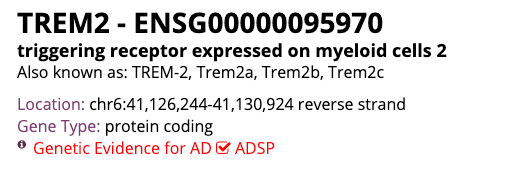
- NOTE: if there is a significant association, you will see the message “Genetic Evidence for AD”, in RED below the gene name, as follows:
 Designing Drugs: From Chemistry to Cure